Author: admin

  • Life with the Current

    Life with the Current

    On staying with what’s here when we really don’t want to

    When I started writing this, I didn’t really want to write.
    It took a lot just to sit down and begin, so it already felt like a small success just to get the first sentence out.
    Some of the best lines come when you don’t want to write at all, and I think that’s true of almost anything — some of the most surprising experiences arrive when we’re not looking for them.

    The alternative to doing is to stay — to not do the thing that takes you away.

    But how do we stay?
    Often it feels pointless, like there’s nowhere to go and nothing to change.
    Like now: I don’t want to write because I’m not comfortable with the state I’m in.
    It’s hard to stay with what’s here.
    But something in me says: what if you could?
    What if you could stay with this, exactly as it is?

    What if even this was okay — that you could let it in,
    and the world would still be the same?
    What if nothing fell apart, and the ground beneath you grew even firmer still?

    There has to be some real, felt benefit to letting go, otherwise we won’t do it.
    It’s easy to say “stay with what’s bothering you,”
    but quite another thing to actually do it.

    Without guidance, we default to coping — trying to fix, avoid, or analyse.
    But what if the task isn’t to figure it out,
    but to make space for a different kind of intelligence?
    Not one that originates in the mind,
    but in the deeper self —
    the one that knows how to guide us beyond the polarity of fear and desire.

    That intelligence is its own medicine.
    It carries a quiet sense that things are somehow in their right place,
    even when the personality is screaming otherwise.

    I once saw an image in a card deck of a person floating down a river on their back,
    completely at ease in the current.
    The card’s message was simple: Go with the flow.
    To trust something beyond our thinking intelligence.

    That life force can be terrifying to our parts,
    because it isn’t predictable.
    It moves where it wants, and it will take us in new directions.

    When I was in my twenties, a teacher of metaphysics once said to me,
    “Ryan, you’re afraid of the ground floor.”
    He was right.
    I was clinging to the banks of the river for dear life —
    trying to control what couldn’t be controlled.

    We forget there’s a kind of mystery at work
    that can’t operate while we’re clutching the sides.
    It asks for a leap of faith —
    not in a naïve way,
    but in the way of someone who’s gatvol (Afrikaans for “more than enough”)
    of pushing upstream.

    Beyond all the unfairness, the resentment, and the striving,
    there comes a moment where we say:
    Alright life, do with me what you will.

    That’s not giving up —
    that’s surrendering into participation.

    The river doesn’t always turn your life upside down.
    Sometimes it just changes how you show up.
    It helps you break small patterns —
    the ways you withhold care from yourself,
    or move too fast to notice what’s already trying to happen.

    This life energy is responsive to the moment.
    It doesn’t argue with what life is presenting.
    Like water, it finds its way —
    not through effort, but through surrender.
    It lives in the present,
    unbound by the past, yet informed by its lessons.

    That force is powerful and, yes, scary — because it’s ours.
    Many of us were taught not to trust it.
    But what if the storm you imagine would never come?

    It’s like opening a tap.
    You don’t have to open it all at once.
    Just enough to let life in —
    and give yourself a chance to acclimatise.
    It can feel overwhelming to open too fast,
    so we learn to sense how much we can handle.

    Opening the tap is the medicine.
    Because as frightening as it can be,
    it also feels deeply good to be connected again.

    It’s a twofold process.

    Let life in.
    Work with the parts that can’t or won’t.

    Those parts are usually the ones most longing to trust again —
    to believe that something good is possible.

    A question I find helpful is:
    What would you do if you weren’t afraid?

    That thing you really want to do, but are afraid to —
    that’s probably the thing you should.

    🌿
    Maybe this week, notice where you’re still trying to push the river.
    What would it mean to soften, even a little —
    to stay with what’s here,
    and to trust that life, in its own way, knows exactly where to go?

  • The Art of getting it wrong

    The Art of getting it wrong

    A Place to Make Mistakes

    Every day, you and I wake up to endless opportunities to do things differently. And yet, with all this freedom, we keep doing the same things—same behaviours, over and over. And so we should. That’s just how personality works; by definition, it’s comprised of patterns, and patterns are predictable and repetitious by nature.

    That doesn’t mean we can’t change, but it does suggest that we would do well to lower our expectations. The critic in me will say, No way, we can’t do that. That would be like giving up on getting anywhere. But just think about it—when have you ever seen anyone change quickly and maintain it? It just doesn’t work like that. Growth is a forward-and-backward game, and what counts over time is more forward than backward.

    We have to be patient and willing to go backward—many times over. Progress can also be measured by not going back as far. That’s kind of incredible, actually. You pulled yourself out a little sooner. That’s something worth celebrating. It absolutely honours our imperfect nature. We weren’t supposed to have it together the whole time.

    This idea that I often see show up in my head—that I should be a certain way—does nothing to save me from the cycle; it just exacerbates it. I feel worse because of the discord between where I am and where I think I should be. There’s that control in me again, the one that has a fixed idea about how things ought to be.

    One of the best ways I’ve heard it put is by Byron Katie, who simply says, “When you fight against reality, you only lose 100% of the time.” That’s because no thought has ever changed the reality of this moment. Right now, things are exactly as they are. Our inner world—thoughts, feelings, sensations—all arise and change moment by moment. The control in me isn’t making any of that happen. Just check—do you really think you’re in control of any of it?

    Same with the outer world. Sounds, movements, everything happening outside of us—it’s all unfolding on its own. Where we do have some control is in how we respond to it. And here, I want to suggest something completely counterintuitive: to get a different response, a really good practice is creating space for intentional mistake-making.

    In this modern world, no one is handing out prizes for mistakes. But I think that might be a giant mistake of its own. Giving ourselves permission to really get it all wrong—even if it ends up looking right in the end—is one way we can exercise our freedom.

    I don’t mean that we should unnecessarily make mistakes. But bringing it back to my initial point—when we feel like we can put down that inner critic and show up as we are, we are bound to get it wrong. And that’s a good thing. It means we are in the practice.

    How to Make a Place for Mistakes

    Here are a few ways, though there are many. The key is to relax the stakes. Whatever the activity, make an agreement with yourself: I do this for its own sake, not for the end result.

    1. Art – I recently spoke to an artist who reinforced this idea. She said it’s often hard to start when she puts pressure on herself to get it right. I asked her what she thought about a mistakes board—a rough space where nothing else matters except following her inner artist and just getting it out without an agenda. So one way to practice this is through art. Whatever your medium, just allow yourself to be in the creative energy.
    2. Journaling – This is my favourite. If you make it super easy to be on the page and let your pen move, you’ll come face-to-face with all the ways your inner critic thinks it’s “going wrong.” And that is the medicine—the practice of letting go, of realizing it doesn’t need to be anything. We can just unravel and allow what will come to come.

    The only reason journaling feels hard is because of that same critical part that insists it should look a certain way, or that we should be producing something. But on paper, we have a wonderful opportunity to let it all go. The key is to make it as easy as possible—you don’t have to write a lot. Even one sentence is something. But it does have to come from inside. Speak for something in you. Let it flow as much as you can. When you recognize yourself holding back, here’s the really cool part—you can let that speak too.

    1. Dance – This is my absolute favourite. You can move for just two minutes—even that counts. If you move more, great. Again, let it flow without feeling like you need to push, but also without holding back. Give your body permission to move in whatever way it wants. Make as many “mistakes” as you need. Let the beat find you. Let the rhythm find you.

    Beat is as old as the stars. The dancer in us knows what to do with it when it comes.

    Think fire, story, song, and movement. It all goes back to the beginning. It’s what makes us who we are at our core. And these medicines—these practices—are what ultimately heal us. Because they speak the language of the soul.

  • Music as Medicine: How Sound Transforms Us

    Music as Medicine: How Sound Transforms Us

    Daniel Levitin, a neuroscientist and musician, has long explored the deep connections between music and the brain. His work suggests that music is more than entertainment—it is medicine. Just as pharmaceuticals interact with neurochemistry to heal the body and mind, music influences neural pathways, reducing stress, enhancing mood, and even alleviating pain. Levitin’s research highlights how rhythm, harmony, and melody engage the brain’s reward system, promoting the release of dopamine, serotonin, and oxytocin—key neurotransmitters linked to well-being.

    Levitin’s books, including This Is Your Brain on Music and The Organised Mind, emphasise that music is fundamental to human cognition and emotional regulation. He explains that our brains evolved to process music as a survival tool, enhancing social cohesion, memory, and emotional processing. One of his key insights is the role of predictive coding in music—our brains anticipate patterns in melody and rhythm, creating a sense of pleasure when those expectations are met or creatively subverted. Additionally, he underscores how different musical structures can induce specific states, such as relaxation through slow tempos and syncopation or alertness through fast, rhythmic beats.

    In therapeutic settings, music has been shown to be particularly effective in managing anxiety, depression, and neurodegenerative diseases. Its structured yet emotionally rich nature provides a framework for cognitive and emotional processing, much like a well-balanced medicinal compound. This idea has taken on new significance in the realm of psychedelic-assisted therapy, where music serves as a guide through altered states of consciousness. Carefully curated soundscapes in psilocybin, MDMA, and ketamine therapy sessions help patients navigate profound emotional and psychological landscapes. Music in this context is not background noise but an active agent, shaping experiences, anchoring insights, and fostering deep healing.

    Levitin’s perspective encourages us to see music not just as art, but as a fundamental component of human health. As research continues to illuminate its therapeutic power, we move closer to a future where medicine is not only prescribed in pills but also in melodies, harmonies, and rhythms—soundscapes that heal from the inside out.

    Where music is different from speech is that it is a whole-brain activity.

    Speech activates a speech network, but music activates every area of the brain we know of—it’s a whole-brain activity. That’s according to a study undertaken by Daniel Levitin.

    Music connects parts of the brain that may not otherwise be connected, making it a great unifier of the brain. Music with a beat and rhythm naturally makes you want to move—babies do it instinctively before they even understand it.

    Infants go through speech babbling, which is well-known, but they also go through a kind of musical babbling, which often precedes speech babbling. They naturally play with song and sound. Levitin believes this is because music is hardwired in us; we are a musical species. Infants are doing what other species have always done—birds and whales had song long before humans existed. The idea is that music is innate and fundamental.

    What’s crucial here is that children respond to music even before they know it means anything. That’s the power of music—it doesn’t have a specific meaning. Composers and lyricists can have an intent, but good music contains the kind of ambiguity that good poetry does. Music is intentionally non-referential—there is no melody that will tell you to open the door, for instance. Music, by its nature, allows us to map our own experience onto this canvas of sound. Depending on our mood, we experience music differently.

    The mammalian brain is a pattern detector; it is a prediction device—anticipating what will happen next to avoid harm. Music is a wonderful exercise and play for the brain because it is highly structured. The essence of music is that it engages the brain in a giant game of expectation and prediction. That’s why it can be so engaging—it moves us to make meaning, and each of us does so in our own unique way.

    1. Create Personalised Playlists
      • Build playlists for different emotional states—calmness, focus, joy, or release. These can be your go-to when you need them.
      • Use music with steady rhythms for relaxation and high-energy beats for motivation.
    2. Use Music to Regulate Emotions
      • Turn to music consciously when feeling overwhelmed or low.
      • Experiment with different genres to discover what best soothes or energises you.
    3. Develop a Daily Music Habit
      • Start and end your day with intentional listening.
      • Incorporate background music into activities like cooking, reading, or working out.
    4. Engage Actively with Music
      • Sing, hum, or play an instrument to enhance the therapeutic effects.
    5. Curate Music for Deep Experiences
      • Use binaural beats or nature sounds to deepen relaxation and introspection.

    Levitin often highlights the importance of developing musical appreciation through exposure to a variety of styles. For those looking to deepen their engagement with music, he suggests exploring:

    • Johann Sebastian Bach – Known for mathematical precision and emotional depth, Bach’s compositions, such as Goldberg Variations and Cello Suites, are excellent for focus and relaxation.
    • Ludwig van Beethoven – His symphonies, particularly Symphony No. 6 (Pastoral) and Moonlight Sonata, can be deeply moving and meditative.
    • Brian Eno – A pioneer in ambient music, his albums like Music for Airports and Apollo are widely used in therapeutic settings.
    • Max Richter – His album Sleep is specifically designed to promote deep rest and relaxation.
    • Philip Glass – His minimalist compositions, such as Glassworks, create a hypnotic effect that can aid in meditation and emotional processing.
    • Alice Coltrane – Combining jazz with spiritual depth, albums like Journey in Satchidananda are excellent for contemplative states.
    • Ravi Shankar – His classical Indian sitar compositions are known for their meditative and trance-inducing qualities.
    • Gustav Mahler – His symphonies, particularly Symphony No. 2 (Resurrection), Symphony No. 5, and Symphony No. 9, are known for their vast emotional range and introspective depth, making them powerful for catharsis and reflection.

    Peter Levine, known for his work in Somatic Experiencing, uses sound and vocalisation to regulate the nervous system. Two key techniques include:

    1. Sound of Enonation – This involves humming or vocalising sounds such as “Ahh,” “Ooo,” or “Mmm,” allowing the vibrations to resonate through the body. This helps release tension, regulate emotions, and calm the nervous system.
    2. Voo Sound Technique – A powerful grounding method where one takes a deep breath and exhales while making a deep “Voooooo” sound. This vibrates the diaphragm and vagus nerve, promoting relaxation and a sense of safety.

    Joni Mitchell, the legendary singer-songwriter, experienced a life-altering health crisis when she suffered a brain aneurysm in 2015. The condition left her unable to walk or speak, and her recovery seemed uncertain. However, music played a vital role in her healing process. Daniel Levitin played an integral part of her recovery.

    As part of her rehabilitation, Mitchell re-engaged with music by listening to her own songs and playing the guitar again. The act of strumming and singing helped rebuild her neural connections and restore her motor skills. She also immersed herself in jazz and classical music, which she had long admired. Over time, the rhythm, melody, and engagement with music contributed to her physical and emotional recovery, allowing her to regain her strength and even return to performing live in 2022.

    Joni Mitchell’s journey illustrates how music can be an essential tool for healing—supporting brain plasticity, emotional resilience, and the restoration of lost abilities. Her story reinforces the power of sound and rhythm in recovery.


    By integrating these musical habits into daily life (in a playful way) and exploring masterful compositions, music becomes a reliable therapeutic tool—offering a means to regulate emotions, deepen experiences, and enhance overall well-being.

    Practice suggestion – Take a moment to reflect on the role music has played in your life. What songs or compositions do you turn to when you’re going through a hard time? Consider making a personal playlist of music that soothes, energises, or brings you comfort. By intentionally curating a selection of tracks that truly resonate with you, you create a powerful resource—one that becomes a source of comfort and healing during those times when music really is the only medicine.

  • Why you should know your state?

    Why you should know your state?

    The thing about state is we often don’t know we are in one, and yet we are. It’s running us, even if we feel like we’re in control; it’s often not the case.

    Why Should We Know Our State?

    I’ll try to make a compelling case that this should be a top priority item for daily living. Because state shows up in every moment of our lives and determines our capacity for creative response to what life brings.

    What Are the States?

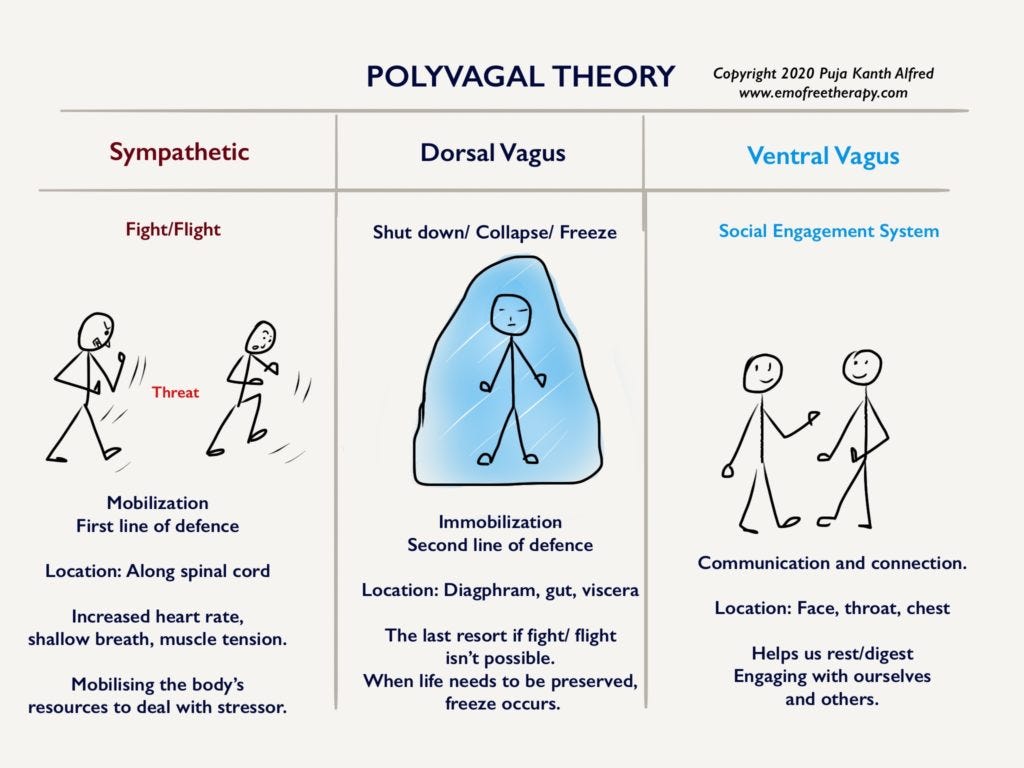
    According to polyvagal theory, we have three distinctive states, but it’s better to see all three as co-emerging, with one being more dominant.

    Deb Dana, who is the leading translator of Dr. Stephen Porges’ Polyvagal Theory for general and clinical audiences, describes the three autonomic states of the nervous system as follows:

    • Ventral Vagal (Safe & Connected): This state is characterised by feelings of safety, connection, and social engagement. When in ventral vagal, we feel open, curious, and able to communicate effectively. Our body is regulated, and we can engage in relationships and the world with a sense of ease.
    • Sympathetic (Fight or Flight): This is the mobilisation state, activated when the nervous system perceives a threat. The sympathetic nervous system prepares us for action—either to fight (defend ourselves) or flee (escape danger). In this state, we may feel anxious, restless, irritable, or overwhelmed, with increased heart rate and tension.
    • Dorsal Vagal (Shutdown & Collapse): This is the immobilisation state, activated when a threat feels overwhelming or inescapable. The dorsal vagal system pulls us into shutdown, dissociation, numbness, or depression as a survival response. In this state, we may feel disconnected, drained, hopeless, or frozen, withdrawing from the world and our sense of self.

    These states are fluid and hierarchical, meaning we move between them throughout the day, depending on our experiences and perceived safety.

    The idea is to notice more quickly when we’re in a protective state and understand what we need to return to the safety and connection of the ventral vagal state. For many of us, especially in modern life, survival and stress have become so normalised that we may have even lost a reference to what safety even feels like inside.

    The ongoing practice is about bringing awareness to what is otherwise automatic and unconscious. It’s not our nervous system’s fault that it’s moving us into these stressful cycles. It’s a misreading of the environment and other people that is rooted in the past. Had we resolved those difficult and overwhelming experiences of our childhood and beyond, we would have much more of an experience of safety inside. Not all that different from a meal you digested well—there is no residual left over.

    Look to nature: prey animals are under threat on an ongoing basis, yet in the wild, they do not get traumatised. Why? Because there is no mind that gets in the way of the body. After an animal goes through a survival response—fight, flight, or freeze—it does the most obvious thing before it can acclimatise back in the herd. It discharges, releases all that energy that got mobilised for survival. The animal often shakes, tremors, releases the activation cycle, and returns to homeostasis.

    How we are different is that we don’t get taught to follow the body and often hold in all that energy, so that even decades later, the same cues trigger those sensations. And again, typically, no one shows us how to befriend them and allow them to complete their cycles.

    In modern life, we likely shift between these states more often than we realise. When we’re in them, it can feel as though we become fully immersed, losing the ability to observe ourselves. The key is to step back and notice the sensations and energies in the body, as it communicates our state through the language of sensation. Our state shapes our perspective and brings a subjective experience. The body feels a certain way, and these sensations can be difficult to stay with—often leading us to resist or struggle against the state we are in.

    The key point is that when we are in a stress response or a protective state, we are not in a place that supports connection. Life feels harder, so it makes sense to learn how to shift back to a calm and connected state (ventral vagal), where creative responses come more naturally—it’s a feature of the state itself. The work is to learn to regulate your nervous system by tuning into the sensations in your body and allowing it to communicate what it needs.

    Here is a simple exercise to get you started in understanding your state and how it’s moving in your day:

    Pause a few times in the day; even a few minutes is enough. Ask yourself, “How is my state?”

    Don’t rush to answer; step back and observe. Notice what your body tells you. Look through these words and see which ones are relevant for you. For a few minutes, do the thing that you don’t want to do: stay with them. Allow them and notice, without wanting them to change, how they change on their own. Also, notice the pleasant sensations, as much as you do the unpleasant. And if it feels like it’s all unpleasant, then try to find at least one place in the body that’s neutral or not so active. There will always be an island of calm somewhere in the body.

    Here are a few words that may help you identify what’s happening in the body:

    Words for Calm or Grounded States:

    • Warm
    • Relaxed
    • Open
    • Soft
    • Expansive
    • Fluid
    • Centered
    • Comfortable
    • Heavy
    • Stable
    • Steady
    • Supported
    • Nourished
    • Spacious

    Words for Stress or Tension:

    • Tight
    • Stiff
    • Constricted
    • Heavy (in a different way)
    • Tense
    • Uneasy
    • Rigid
    • Uncomfortable
    • Throbbing
    • Pulsing
    • Restless
    • Cold
    • Numb
    • Fluttering
    • Uneven
    • Clenched