Category: Somatics

  • Choosing the Hard Thing

    Choosing the Hard Thing

    If you are not prepared for the hard thing, given the opportunity, you’ll go for the easy option. Case in point: me.

    I intend to do this writing—the hard thing—and then I click on my browser and YouTube wants to tell me about F1, the easy thing. No disrespect towards the easy action. For some reason, I love to watch cars speed around a race track at ridiculous speeds. But it’s a very easy action to take. It takes much more to stay with the hard thing.

    Here are some thoughts about why that is so, and what we can do to make the harder thing easier. Which sounds like a kind of oxymoron, but what if the hard thing is what you really want? The choice that’s most likely to fill you up.

    Life is full of these hard actions we avoid doing. Once I’ve set my mind on something, guaranteed something else will come and pull me in a different direction. And let’s say I click on that seductive video, what’s the true cost, aside from the time lost? I’d argue it’s usually more than we think.

    What I forget is that it’s my life I’m giving—these small moments that make up the bigger arcs of time. That become the patterns that shape my future self.

    These small choices matter. At the same time, I can also err in the other direction, putting pressure on every moment to make it count. That’s its own form of insanity. So what does the middle ground look like? How do I do more of the hard things, without making life impossibly hard overall?

    One way is to give yourself permission to do nothing at all which, it turns out, is a lot harder than it seems. And possibly a step up from the F1 video that calls to the distractor parts of me. These moments of pause and non-doing are sometimes themselves expressions of the hard thing. Especially in modern society, where we have to contend with all the voices calling us lazy or unproductive. But what if the pause gives you the space to find the right action?

    Epictetus, in his way, warned against wishing life away. Even the waiting is part of it. You remember wanting to get there, on the way to the beach. But you wouldn’t actually want to fast-track it so that you didn’t have the experience of not being there yet. That part is just as valid as arriving—an expression of life.

    There are all kinds of moments, and we can’t hope to be doing the most productive thing in every one. But we can aim for the hard part: to stay with experience, especially when it isn’t the way we want it to be.

    “Don’t demand that things happen as you wish, but wish that they happen as they do happen, and you will go on well.” —Epictetus

    Back to my F1 example: does doing the hard thing mean I should never exchange ten minutes of my life for the experience of seeing cars go fast around a track? To my mind, not at all. We have a very real need for non-directional time, especially in a modern context. If it’s always about doing and achieving, we’re sure to run into crisis at some point.

    Time that’s playful in nature, or relaxing, or that disconnects us from the directional drive of our lives—that time is essential.

    There’s also no way to avoid getting distracted. I don’t imagine there’s anyone on this planet who’s 100% focused all the time. It’s more realistic to see distraction as a normal, even useful part of the day. You can wake up inside the distraction, and see what it’s trying to do for you.

    Most of the time, it’s just trying to take us away from discomfort or pain. But what if we stayed with the uncomfortable experience, even if that’s just our old friend boredom? It could be anything. What happens when you don’t resist it, but let it in for a moment—get to know it, even if just for 30 seconds? Doing nothing more than not trying to change your experience.

    As Gary Keller likes to say:
    “What’s the ONE Thing I can do such that by doing it, everything else will be easier or unnecessary?”
  • The Art of getting it wrong

    The Art of getting it wrong

    A Place to Make Mistakes

    Every day, you and I wake up to endless opportunities to do things differently. And yet, with all this freedom, we keep doing the same things—same behaviours, over and over. And so we should. That’s just how personality works; by definition, it’s comprised of patterns, and patterns are predictable and repetitious by nature.

    That doesn’t mean we can’t change, but it does suggest that we would do well to lower our expectations. The critic in me will say, No way, we can’t do that. That would be like giving up on getting anywhere. But just think about it—when have you ever seen anyone change quickly and maintain it? It just doesn’t work like that. Growth is a forward-and-backward game, and what counts over time is more forward than backward.

    We have to be patient and willing to go backward—many times over. Progress can also be measured by not going back as far. That’s kind of incredible, actually. You pulled yourself out a little sooner. That’s something worth celebrating. It absolutely honours our imperfect nature. We weren’t supposed to have it together the whole time.

    This idea that I often see show up in my head—that I should be a certain way—does nothing to save me from the cycle; it just exacerbates it. I feel worse because of the discord between where I am and where I think I should be. There’s that control in me again, the one that has a fixed idea about how things ought to be.

    One of the best ways I’ve heard it put is by Byron Katie, who simply says, “When you fight against reality, you only lose 100% of the time.” That’s because no thought has ever changed the reality of this moment. Right now, things are exactly as they are. Our inner world—thoughts, feelings, sensations—all arise and change moment by moment. The control in me isn’t making any of that happen. Just check—do you really think you’re in control of any of it?

    Same with the outer world. Sounds, movements, everything happening outside of us—it’s all unfolding on its own. Where we do have some control is in how we respond to it. And here, I want to suggest something completely counterintuitive: to get a different response, a really good practice is creating space for intentional mistake-making.

    In this modern world, no one is handing out prizes for mistakes. But I think that might be a giant mistake of its own. Giving ourselves permission to really get it all wrong—even if it ends up looking right in the end—is one way we can exercise our freedom.

    I don’t mean that we should unnecessarily make mistakes. But bringing it back to my initial point—when we feel like we can put down that inner critic and show up as we are, we are bound to get it wrong. And that’s a good thing. It means we are in the practice.

    How to Make a Place for Mistakes

    Here are a few ways, though there are many. The key is to relax the stakes. Whatever the activity, make an agreement with yourself: I do this for its own sake, not for the end result.

    1. Art – I recently spoke to an artist who reinforced this idea. She said it’s often hard to start when she puts pressure on herself to get it right. I asked her what she thought about a mistakes board—a rough space where nothing else matters except following her inner artist and just getting it out without an agenda. So one way to practice this is through art. Whatever your medium, just allow yourself to be in the creative energy.
    2. Journaling – This is my favourite. If you make it super easy to be on the page and let your pen move, you’ll come face-to-face with all the ways your inner critic thinks it’s “going wrong.” And that is the medicine—the practice of letting go, of realizing it doesn’t need to be anything. We can just unravel and allow what will come to come.

    The only reason journaling feels hard is because of that same critical part that insists it should look a certain way, or that we should be producing something. But on paper, we have a wonderful opportunity to let it all go. The key is to make it as easy as possible—you don’t have to write a lot. Even one sentence is something. But it does have to come from inside. Speak for something in you. Let it flow as much as you can. When you recognize yourself holding back, here’s the really cool part—you can let that speak too.

    1. Dance – This is my absolute favourite. You can move for just two minutes—even that counts. If you move more, great. Again, let it flow without feeling like you need to push, but also without holding back. Give your body permission to move in whatever way it wants. Make as many “mistakes” as you need. Let the beat find you. Let the rhythm find you.

    Beat is as old as the stars. The dancer in us knows what to do with it when it comes.

    Think fire, story, song, and movement. It all goes back to the beginning. It’s what makes us who we are at our core. And these medicines—these practices—are what ultimately heal us. Because they speak the language of the soul.

  • Why you should know your state?

    Why you should know your state?

    The thing about state is we often don’t know we are in one, and yet we are. It’s running us, even if we feel like we’re in control; it’s often not the case.

    Why Should We Know Our State?

    I’ll try to make a compelling case that this should be a top priority item for daily living. Because state shows up in every moment of our lives and determines our capacity for creative response to what life brings.

    What Are the States?

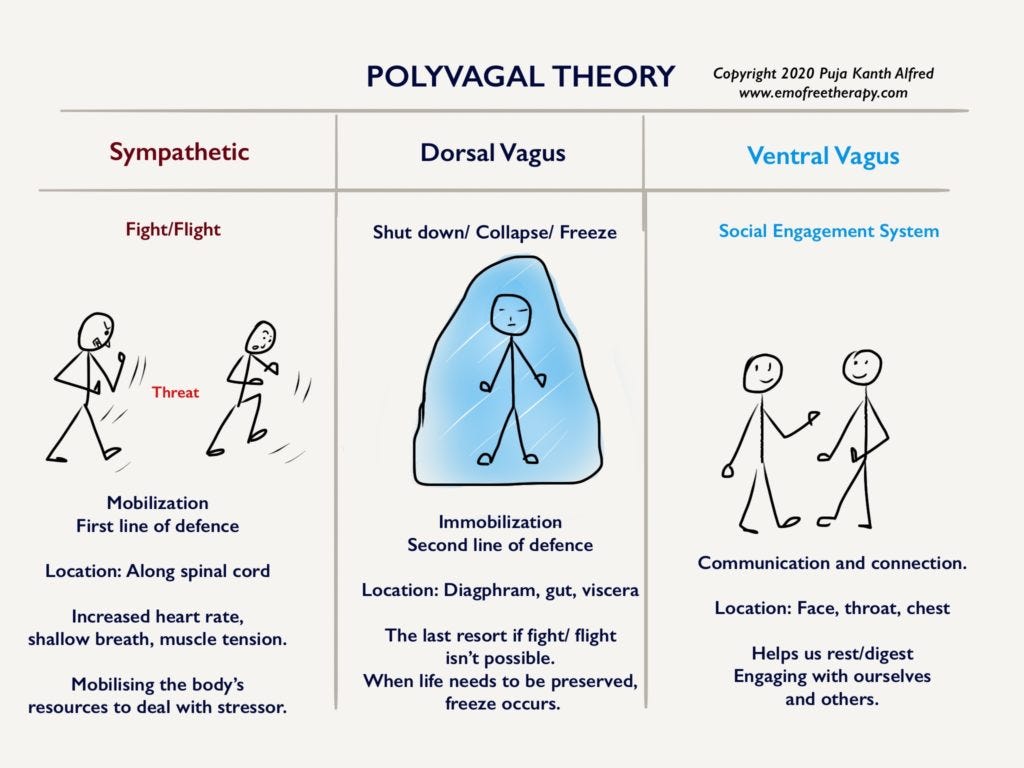
    According to polyvagal theory, we have three distinctive states, but it’s better to see all three as co-emerging, with one being more dominant.

    Deb Dana, who is the leading translator of Dr. Stephen Porges’ Polyvagal Theory for general and clinical audiences, describes the three autonomic states of the nervous system as follows:

    • Ventral Vagal (Safe & Connected): This state is characterised by feelings of safety, connection, and social engagement. When in ventral vagal, we feel open, curious, and able to communicate effectively. Our body is regulated, and we can engage in relationships and the world with a sense of ease.
    • Sympathetic (Fight or Flight): This is the mobilisation state, activated when the nervous system perceives a threat. The sympathetic nervous system prepares us for action—either to fight (defend ourselves) or flee (escape danger). In this state, we may feel anxious, restless, irritable, or overwhelmed, with increased heart rate and tension.
    • Dorsal Vagal (Shutdown & Collapse): This is the immobilisation state, activated when a threat feels overwhelming or inescapable. The dorsal vagal system pulls us into shutdown, dissociation, numbness, or depression as a survival response. In this state, we may feel disconnected, drained, hopeless, or frozen, withdrawing from the world and our sense of self.

    These states are fluid and hierarchical, meaning we move between them throughout the day, depending on our experiences and perceived safety.

    The idea is to notice more quickly when we’re in a protective state and understand what we need to return to the safety and connection of the ventral vagal state. For many of us, especially in modern life, survival and stress have become so normalised that we may have even lost a reference to what safety even feels like inside.

    The ongoing practice is about bringing awareness to what is otherwise automatic and unconscious. It’s not our nervous system’s fault that it’s moving us into these stressful cycles. It’s a misreading of the environment and other people that is rooted in the past. Had we resolved those difficult and overwhelming experiences of our childhood and beyond, we would have much more of an experience of safety inside. Not all that different from a meal you digested well—there is no residual left over.

    Look to nature: prey animals are under threat on an ongoing basis, yet in the wild, they do not get traumatised. Why? Because there is no mind that gets in the way of the body. After an animal goes through a survival response—fight, flight, or freeze—it does the most obvious thing before it can acclimatise back in the herd. It discharges, releases all that energy that got mobilised for survival. The animal often shakes, tremors, releases the activation cycle, and returns to homeostasis.

    How we are different is that we don’t get taught to follow the body and often hold in all that energy, so that even decades later, the same cues trigger those sensations. And again, typically, no one shows us how to befriend them and allow them to complete their cycles.

    In modern life, we likely shift between these states more often than we realise. When we’re in them, it can feel as though we become fully immersed, losing the ability to observe ourselves. The key is to step back and notice the sensations and energies in the body, as it communicates our state through the language of sensation. Our state shapes our perspective and brings a subjective experience. The body feels a certain way, and these sensations can be difficult to stay with—often leading us to resist or struggle against the state we are in.

    The key point is that when we are in a stress response or a protective state, we are not in a place that supports connection. Life feels harder, so it makes sense to learn how to shift back to a calm and connected state (ventral vagal), where creative responses come more naturally—it’s a feature of the state itself. The work is to learn to regulate your nervous system by tuning into the sensations in your body and allowing it to communicate what it needs.

    Here is a simple exercise to get you started in understanding your state and how it’s moving in your day:

    Pause a few times in the day; even a few minutes is enough. Ask yourself, “How is my state?”

    Don’t rush to answer; step back and observe. Notice what your body tells you. Look through these words and see which ones are relevant for you. For a few minutes, do the thing that you don’t want to do: stay with them. Allow them and notice, without wanting them to change, how they change on their own. Also, notice the pleasant sensations, as much as you do the unpleasant. And if it feels like it’s all unpleasant, then try to find at least one place in the body that’s neutral or not so active. There will always be an island of calm somewhere in the body.

    Here are a few words that may help you identify what’s happening in the body:

    Words for Calm or Grounded States:

    • Warm
    • Relaxed
    • Open
    • Soft
    • Expansive
    • Fluid
    • Centered
    • Comfortable
    • Heavy
    • Stable
    • Steady
    • Supported
    • Nourished
    • Spacious

    Words for Stress or Tension:

    • Tight
    • Stiff
    • Constricted
    • Heavy (in a different way)
    • Tense
    • Uneasy
    • Rigid
    • Uncomfortable
    • Throbbing
    • Pulsing
    • Restless
    • Cold
    • Numb
    • Fluttering
    • Uneven
    • Clenched