
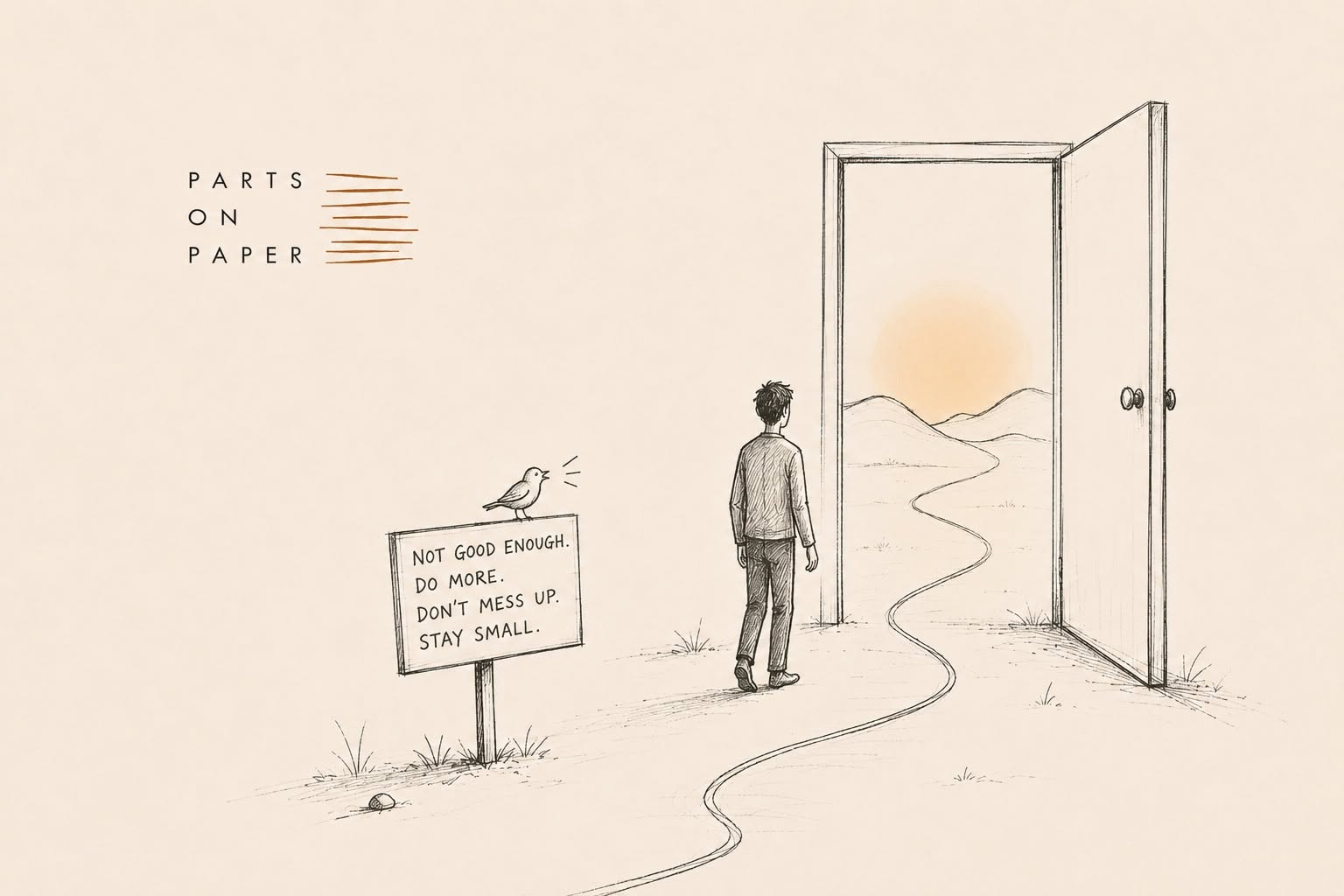
I’ve been thinking and reflecting quite a bit about the critic, and watching others think and reflect on the subject too. One thing I can say with some confidence is that the critic seems like a good way in.
A good connection with, and seeing of, these parts can make a lot of room in the system.
I think our critics are very forthcoming parts. They don’t hold back. They are quick to tell us what’s wrong, what we should have done, what we shouldn’t have done, where we are falling short and what might go wrong. That kind of forthcomingness is not unlike cooperation.
And perhaps the task is to get them on our side.
Our critics have spent most of our lives being on the side of the external world — helping us please, conform, perform, fit in and respond to whatever is expected of us. We don’t necessarily want them to stop cooperating with the outside world. But perhaps we can invite them to cooperate at least as much with the needs on the inside, the authenticity, the truth, the life that is moving on the inside.
When we begin talking about the critic, I have yet to meet anyone who needs any introduction to these parts. We open the critic and people just dive right in. The only reason I can see is that it is so pervasive.
That voice in our head that is always ready to let us know how we aren’t measuring up or, on the odd occasion, how we are. But it’s there. It’s waiting. Its messaging never quite goes away, although it may fade out when we are in our favourite place or in some form of flow.
Once you’re in the zone, maybe the zone takes over. But before and after, the critic is there, taking up far more mental real estate than it needs to.
This is why I think it’s such a good entry point.
Getting to know our critics means that we are also heading in the direction of our vulnerability.
My critic might beat me up for not doing what I should have, for mistakes that I will never come back from. Mistakes that have left me with an underrated life.
I could have been so much more, it tells me.
And look what you have become.
To bypass a voice like that in my head would almost be sacrilege. It’s telling me exactly where I need to go because, as soon as I hear the criticism, there is a way into the vulnerability underneath it.
There are probably many other doors you can pass through, each with a guard at the entrance. But what’s unique about the critics is that, when we engage them, they seem to have this way of lighting up the whole system. Or maybe more of it than would usually be the case when we approach another protector that protects in ways other than criticism.
There might be a bingeing part there that numbs to feel better. Connecting with that part can be useful. But getting to the critic can bring another level of activity.
Why?
Because critics tend to have an opinion about all the parts, and they are often equally hard on all of them to get their way.
Maybe you just better stop.
What were you thinking, trying this?
Way out of your depth.
Just go back and stay small. Stay where it’s safe.
What were you thinking, that you could get more than you deserve?
When we bring the critics in, I think there is a case to be made that if we can befriend them, they may help us find our way to the other protectors more quickly.
Imagine meeting an addict part, or a frustrated part, or a hopeless one, or an angry one — without all that critical energy around them.
It’s a different kind of entry point. One that may pave the way for conversations we didn’t know we could have.
This is what we’re continuing to explore through Parts on Paper, not how to get rid of the critic, but how to listen differently, and what becomes possible when we do.
Discover your Critic Profile
We’ve created a simple Inner Critic Profile based on the different critic characters we’ve been exploring in our critic groups.
You can use it as an invitation to become curious about your own inner critic, the ways it shows up, what it might be trying to protect, and how familiar these different voices are in your own life.
If you’d like to explore this work more deeply, the next Parts on Paper: Exploring the Inner Critic group begins 10 September. The group is online and combines IFS, journalling and conversation.
Leave a Reply